
 Français
 English




-copie-04.png)





How to choose the right curtain width for your window size?
.png)
It often happens that you find the perfect curtain, but once it is hung, the result is disappointing — it looks too narrow or, conversely, too bulky. Many people make this measuring mistake. Yet it only takes a few simple rules to get it right. Here is how to choose the right curtain width for your windows.
Why does width matter?
If a curtain is too narrow, it looks skimpy and lets light in at the sides. If it is too wide, it can make the room feel heavy. The right width produces a beautiful gather and makes the window look larger. When in doubt, it is better to have slightly too much fabric than too little, because volume creates movement.
The gathered effect: a generous curtain will fall in beautiful folds, whereas one that is too narrow will hang flat and taut.
The optical illusion: a window framed by wide curtains looks larger and brighter, even when drawn during the day.
The basic rule: the gather ratio
To calculate the ideal curtain width, apply a multiplier to the window width:
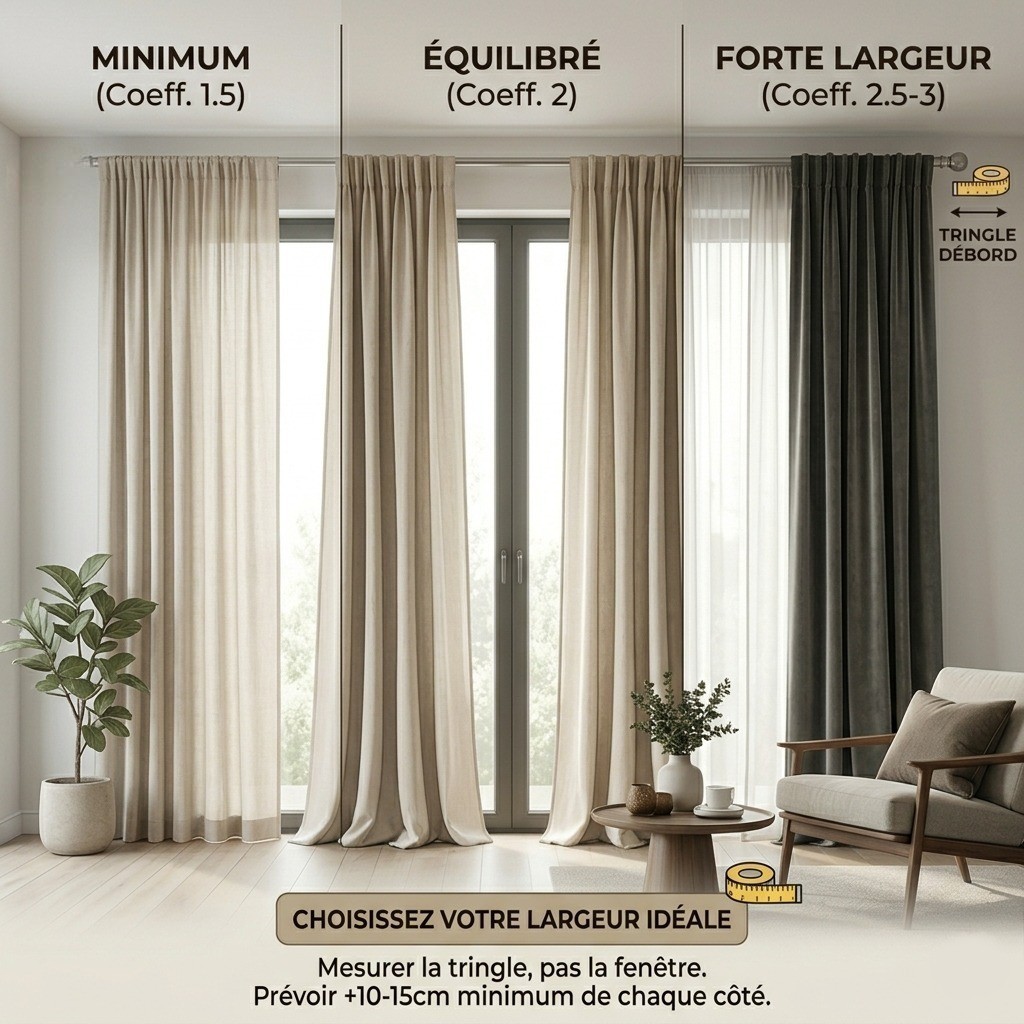
- × 1.5: lightly draped curtain, clean and minimalist style.
- × 2: well-gathered curtain, classic and elegant finish — the most recommended option.
- × 2.5 to 3: very heavily gathered curtain, sumptuous and generous finish, ideal for large rooms or sheer panels.
Practical example: for a 100 cm wide window, plan a curtain between 150 and 250 cm, depending on the desired effect.
Summary table: window → recommended curtain width
|
Window Width |
Curtain Width (min) |
Curtain Width (ideal) |
Style |
|
60 cm |
90 cm |
120–150 cm |
Cosy, intimate |
|
80 cm |
120 cm |
160–200 cm |
Balanced |
|
100 cm |
150 cm |
200–250 cm |
Elegant, airy |
|
120 cm |
180 cm |
240–300 cm |
Theatrical, generous |
|
Patio door (180 cm+) |
270 cm |
360–450 cm |
Grand, full-scale |
These widths refer to a pair of curtains (two panels). Remember to divide by two if you are buying individual panels.
Special cases
Patio doors: For patio doors, allow at least twice the total width. It is recommended to extend the curtain rod 30 to 40 cm beyond each side so the curtains do not block the glass when open.
Tall, narrow windows: For a tall, narrow window, you can cheat by fitting a wider rod and placing it very high, or even at ceiling height. This visually enlarges the opening.
Bay windows: Measure the entire structure rather than each pane separately, then apply the same calculation.
Most common mistakes
- Measuring only the glass and forgetting the frame or the rod, which is often wider.
- Confusing total curtain width with the width of a single panel: if buying two panels, each should be half the total desired width.
- Overlooking the side returns: always allow 10 to 15 cm of overlap on each side of the window for a neat finish.
- Choosing the same width for every curtain in the house: each room has its own dimensions and light requirements.
Before buying, always measure the width of the rod or rail, not just the window itself.
In summary
If you want to be sure you get it right, multiply the width of your rod by two. This is the safe rule for achieving a beautiful drape and a successful installation. Once you have these figures in mind, all that remains is to choose the style you love.
Now that you know your measurements, browse our collection of sheer curtains and panels to find the perfect style for your windows.